

If your heating system struggles to hold a stable temperature setpoint — or if you're replacing an SSR that keeps burning out at high load — the problem is usually the control method, not the heater itself.
A thyristor power controller gives you continuous 0–100% power adjustment instead of simple on/off switching. For industrial furnaces, ovens, and high-power heating systems, that difference matters: smoother temperature curves, less thermal stress on heating elements, and actual closed-loop stability instead of hunting around the setpoint.
How It Works
A 3 phase thyristor power regulator uses pairs of SCRs wired back-to-back to regulate AC power flow to the heating load. What changes the output is when in each AC cycle the SCRs are triggered.
Phase angle firing
The SCR fires at a precise point in each AC cycle, delivering a controlled fraction of the available voltage. Smooth, fast response — you can ramp power up or down in real time. The trade-off is harmonic distortion, which increases at partial power levels.
Use phase angle when the process needs tight power modulation — temperature ramp control, fast-responding infrared elements, or applications where overshoot is not acceptable.
Zero-cross firing
Instead of cutting cycles, the controller passes complete AC cycles through in a controlled ratio. No partial waveforms, no harmonic distortion. For pure resistance wire heaters, zero-cross is almost always the right choice — the load is slow enough that cycle-level switching makes no practical difference, and your grid stays clean.
Closed-loop PID control
The built-in PID loop monitors actual output — voltage, current, or power — and adjusts firing angle continuously. When load impedance or grid voltage shifts, the SCR power controller compensates without manual intervention.
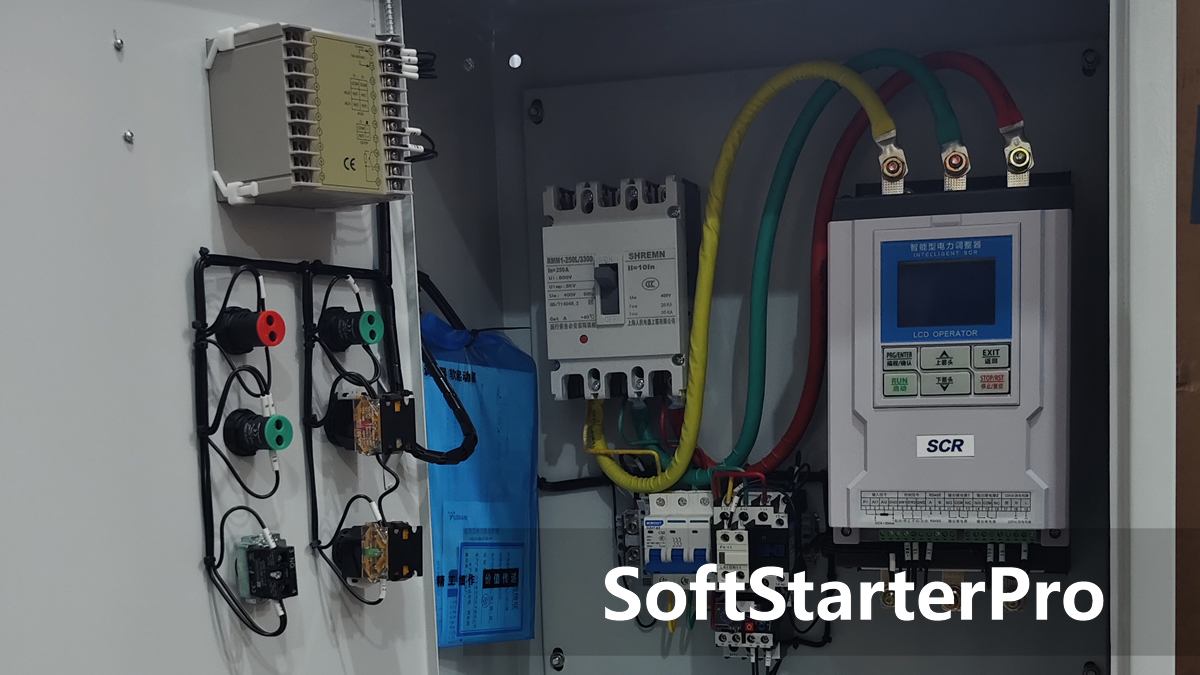
Compatible Load Types
Resistance wire heaters
Stable impedance, predictable behavior. Zero-cross firing keeps the grid clean. Phase angle is an option if the process needs faster response.
Silicon carbide (SiC) rods
Common in high-temperature industrial furnaces. As furnace temperature rises, SiC rod resistance increases — without closed-loop compensation, power output drops and the furnace struggles to reach setpoint. Constant current mode handles this automatically.
Infrared heating elements
Fast thermal response. Phase angle firing with closed-loop control gives the precision needed — zero-cross is too coarse for applications where temperature tracking matters at the second level.
Transformer primary control
Used in induction heating and transformer-coupled furnaces. Confirm the controller is rated for inductive loads before ordering.
Thyristor power controllers are not suitable for motor loads — for motor control, use a soft starter or VFD drive.
Thyristor Power Controller vs Solid State Relay
If you need on/off control for a small resistive load under 15kW, an SSR does the job at lower cost. For anything more demanding, a thyristor heater controller is the right tool.
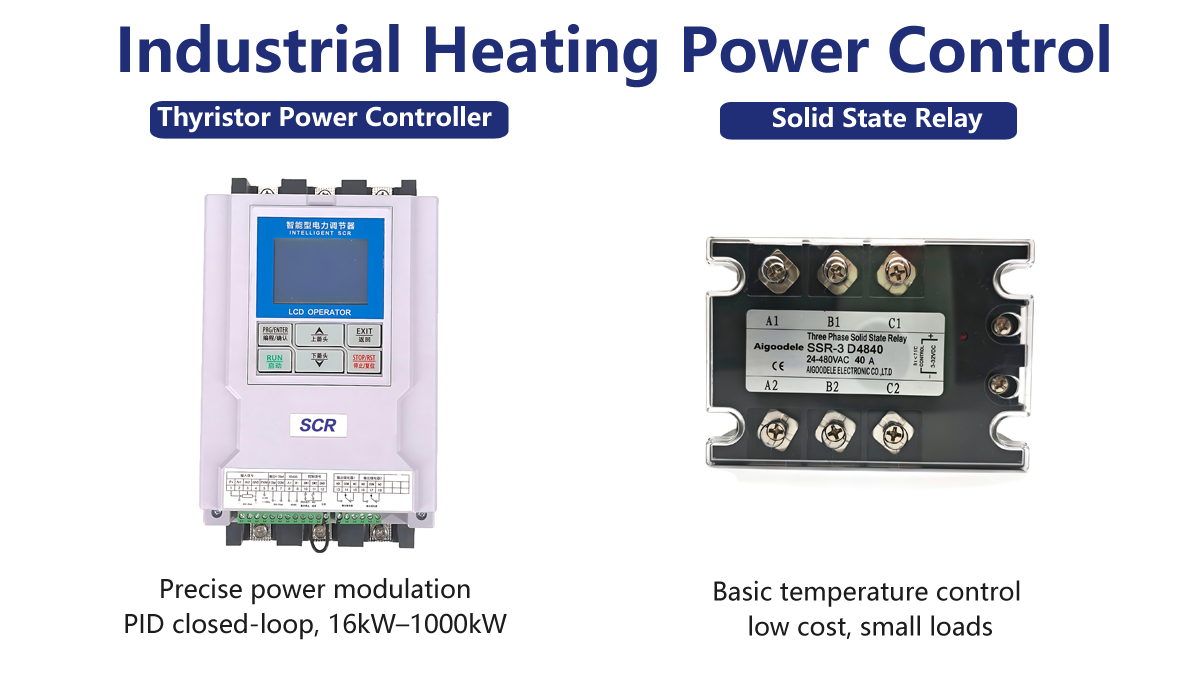
| Thyristor power controller | Solid state relay (SSR) | |
|---|---|---|
| Power control | Continuous 0–100% | On/off only |
| Firing method | Phase angle or zero-cross | Zero-cross (standard) |
| Closed-loop control | Built-in PID | Not available |
| Suitable loads | Resistive and semi-inductive | Resistive only |
| Power range | 16kW–1000kW | Typically under 15kW |
| Display and monitoring | LCD, multi-parameter | None |
| PLC integration | RS485/Modbus, analog input | Basic signal input only |
What a thyristor power controller can do that an SSR cannot:
- Continuous power modulation — temperature holds at setpoint instead of cycling around it
- Closed-loop PID control — compensates automatically for load or grid changes
- RS485/Modbus integration — full remote control from PLC or SCADA
- Built-in protection — phase loss, overcurrent, overheat, and load disconnection detection trigger an alarm before damage occurs
Key Selection Parameters
1. Load power and voltage Select a controller with at least 1.3× safety margin on load power. Common voltage options are 220V, 380V, 415V, and 660V. For detailed sizing and model selection, use the SCR Power Regulator Selection Guide.
2. Load type Resistive, semi-inductive, or transformer-coupled — each has different requirements for firing mode and SCR rating.
3. Control signal and firing mode Match control input to your automation system (4–20mA, 0–10V, RS485/Modbus, or PWM). Choose phase angle for continuous modulation, zero-cross for purely resistive loads where grid cleanliness matters.
4. Cooling and installation Industrial SCR power controllers run hot at full load. Install vertically, ensure exhaust ventilation at the top of the control cabinet, and verify ambient temperature against the product spec before finalizing enclosure design.
5. Protection functions Standard functions include phase loss, overcurrent, overheat, load disconnection, and three-phase current imbalance. Confirm which are enabled by default for your application.
FAQ
Q: Can a thyristor power controller replace an SSR I'm already using?
A: In most cases yes. The performance improvement is significant — stable temperature, closed-loop control, and proper load protection. The only reason to stay with an SSR is cost on very small, simple loads.
Q: Phase angle or zero-cross — how do I choose?
A: If the load is purely resistive and the process doesn't need fast power changes, use zero-cross. If you need precise ramp control or the load responds quickly to power changes, use phase angle.
Browse our Thyristor Power Controllers and Compact Thyristor Power Controllers, or contact us to discuss your heating application.