

A single phase solid state relay DC-AC is a switching device that uses a low-voltage DC control signal to switch AC loads without mechanical contacts. The DC-AC designation means DC input, AC output — making it the most widely used SSR type in industrial automation, temperature control, and PLC-based systems.
Compared to mechanical relays, the DC-AC SSR offers silent operation, longer service life, faster switching, and zero contact wear.
How It Works
The single phase solid state relay DC-AC operates through optical isolation. When a DC control signal (3–32VDC) is applied to the input terminals, it activates an internal LED. The light triggers a photosensitive component, which then activates the output semiconductor (triac or thyristor) to switch the AC load.
Because the control circuit and load circuit are fully isolated, the DC-AC SSR can be directly driven by PLCs, microcontrollers, and other low-voltage logic devices without additional interface components.
Trigger mode:
The standard DC-AC SSR uses zero-cross triggering — the output switches on only when the AC waveform crosses zero voltage. This minimizes inrush current and reduces electrical noise, making it ideal for resistive loads such as heating elements.
Random triggering is available as a custom option for applications requiring faster response or phase control.
Key Specifications
| Parameter | SSR-DA Series |
|---|---|
| Control input | 3–32VDC |
| Load voltage | 24–480VAC |
| Load current | 10–120A |
| Trigger mode | Zero-cross (standard); random (custom) |
| Isolation voltage | 2500V |
| LED indicator | Yes |
| Mounting | Panel mount |
How to Select the Right DC-AC SSR
1. Determine load type and apply the correct current margin
Load type directly affects how much derating is required:
- Resistive loads (heating elements, ovens): select an SSR rated at minimum 3× the actual load current
- Inductive loads (motors, solenoids, transformers): select an SSR rated at minimum 5× the actual load current due to high inrush current at startup
- Capacitive loads (capacitor banks, some power supplies): inrush current can be extremely high — consult before selecting
2. Match control voltage
Confirm your control system output voltage is within 3–32VDC. The DC-AC SSR is compatible with most PLCs, microcontrollers, and temperature controllers.
3. Confirm trigger mode requirement
For standard heating and on/off control applications, zero-cross trigger is sufficient. If your application requires phase-angle control or faster switching response, specify random trigger at time of order.
4. Plan for heat dissipation
All DC-AC SSR units generate heat during operation. A heatsink is required for continuous or high-current use. Higher current ratings require larger heatsinks — factor this into panel layout and ventilation design.
Wiring Instructions
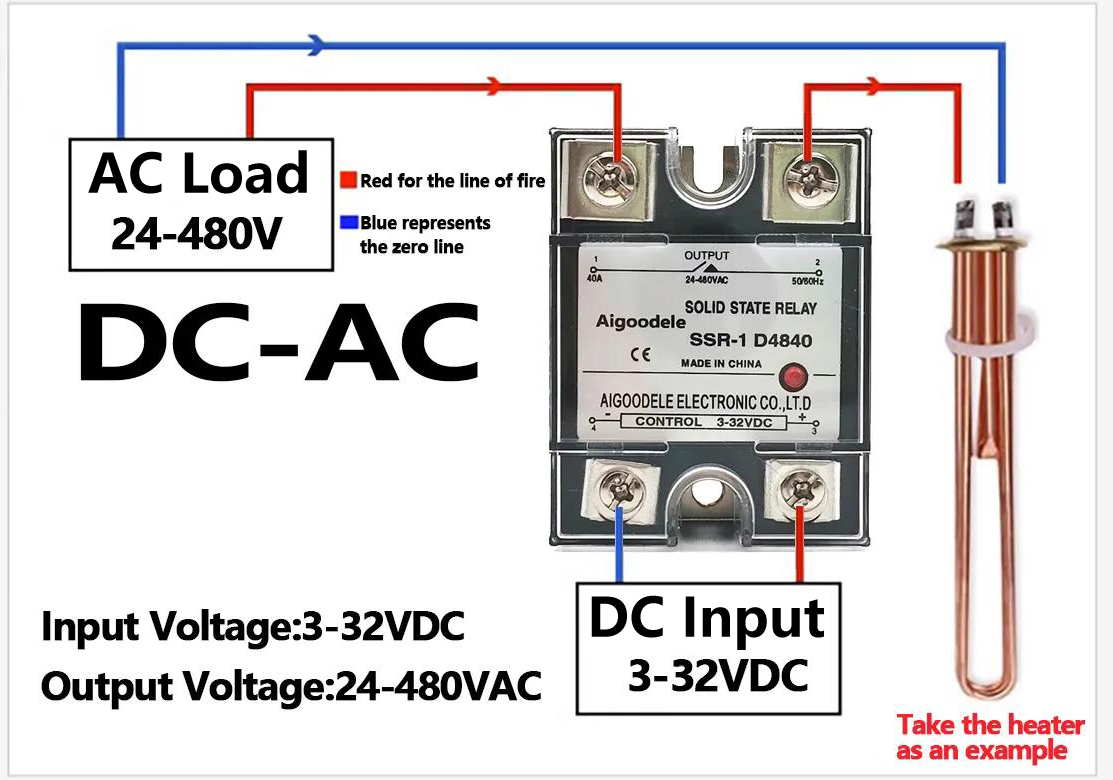
Before wiring, turn off all power.
- Connect DC control input: positive terminal to positive control voltage (3–32VDC), negative terminal to control common. Observe correct polarity.
- Connect AC load output: one terminal to the AC live line, the other terminal to the load. Connect the other end of the load to neutral.
- If a heatsink is required, mount the SSR onto the heatsink using thermal paste to ensure good thermal contact.
- Restore power and apply the control signal to verify the LED indicator lights and the load switches correctly.
- After confirming correct operation, proceed with full load application.
Note: always install a fuse or circuit breaker on the AC output side for overcurrent protection.
Note: like all solid state relays, the DC-AC SSR has a small off-state leakage current (≤5mA). For applications where leakage current is critical, verify system compatibility before use.
Common Applications
- Industrial ovens and kilns — heating elements are purely resistive loads; zero-cross triggering minimizes interference on the power line, and the 3–32VDC input connects directly to a temperature controller or PLC output without additional interface components.
- Plastic injection molding machines — heating bands require frequent switching over long periods; the DC-AC SSR has no mechanical contacts, eliminating the wear and maintenance issues common with mechanical relays.
- PLC-controlled automation systems — the 3–32VDC input is directly compatible with standard PLC output modules, simplifying wiring and removing the need for intermediate relays.
- HVAC temperature control — most temperature controllers output a DC signal; the DC-AC SSR matches directly, and zero-cross triggering reduces electrical noise affecting other equipment in the same panel.
- Food processing and packaging equipment — silent operation and high switching frequency make the DC-AC SSR suitable for environments where noise and vibration must be minimized.
FAQ
Q: What is the difference between DC-AC, AC-AC, and DC-DC solid state relays?
A: DC-AC = DC control, AC load (this product). AC-AC = AC control, AC load. DC-DC = DC control, DC load. Choose based on your control signal type and load type.
Q: Why does the DC-AC SSR need such a large current margin?
A. SSRs generate heat proportional to load current. Operating close to the rated current causes overheating and premature failure. For resistive loads, use 3× margin; for inductive loads, use 5× or more due to startup inrush current.
Q: Does the DC-AC SSR have built-in protection?
A. No. The DC-AC SSR does not include built-in overcurrent or overvoltage protection. External fuses or circuit breakers must be installed on the AC output side.
Browse our Single Phase Solid State Relay collection, or contact us for a free quote.