

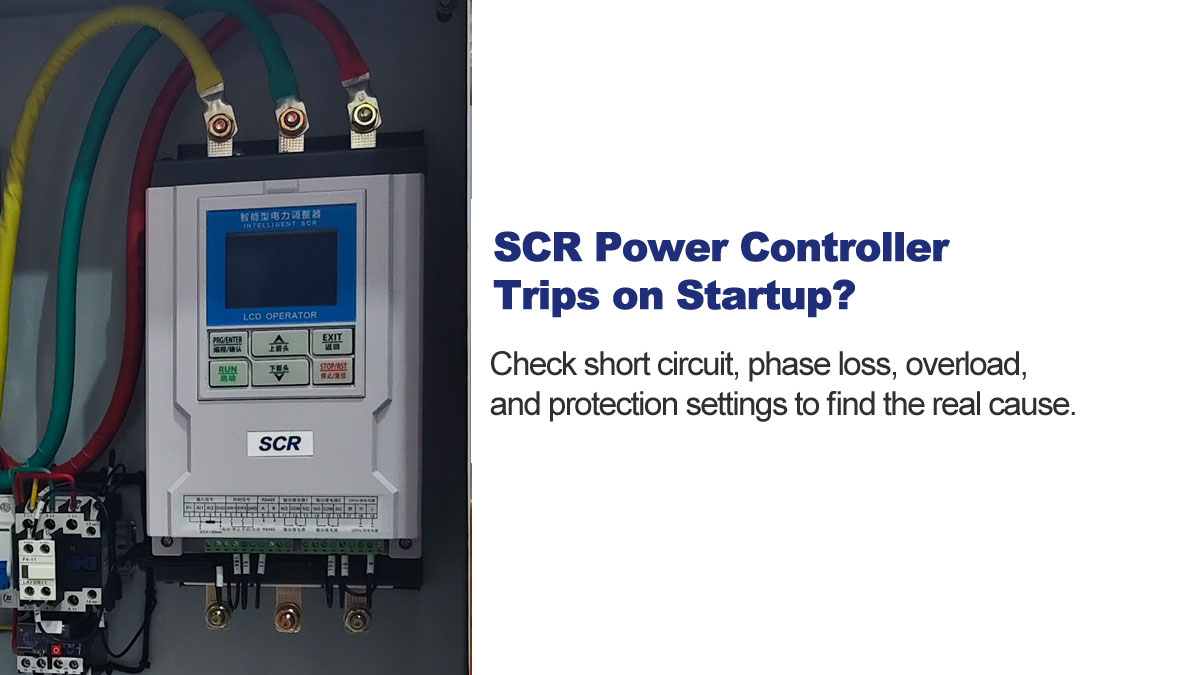
When an SCR power controller trips the breaker the moment it starts up, the first thing most engineers do is check the wiring. That's a reasonable instinct — but in practice, incorrect wiring sequence rarely causes tripping. The breaker is responding to abnormal current, not a wiring error.
This guide explains what actually causes startup tripping, and where to look first.
Does Wrong Wiring Actually Cause Tripping?
It depends on what kind of wiring error you're dealing with.
Swapping input phase sequence on a three-phase system usually doesn't trip the breaker. The controller may behave oddly — a motor might run backwards, or you might get a phase sequence alarm — but the breaker stays closed. The current stays within normal range.
The same goes for reversed output phases. Incorrect phase sequence on the output side typically causes operational problems, not a short circuit. The breaker won't trip from phase sequence alone.
Control signal wiring errors are even less likely to cause tripping. A reversed or incorrect control signal might prevent the controller from starting, or trigger an internal protection alarm — but it doesn't push enough current through the main circuit to open a breaker.
The exception is when a wiring error creates a direct short circuit — two live conductors making contact, or a conductor touching the enclosure. That will trip instantly. But the cause of the trip is the short circuit itself, not the fact that someone wired the phases in the wrong order.
What Actually Causes Startup Tripping
Short circuit
This is the most common cause of immediate tripping on startup. If output terminals are accidentally bridged, or damaged cable insulation allows phases to contact each other, the current spike is large enough to open the breaker within milliseconds.
Check with a multimeter in continuity mode between output terminals and between each terminal and the enclosure. Any reading close to zero resistance where you'd expect an open circuit points to a short.
Phase loss
On a three-phase installation, if one input phase is missing — due to a blown fuse, a loose connection, or a supply issue — the remaining two phases carry unbalanced current. On some systems this pushes current high enough to trip overcurrent protection at startup, when load demand is highest.
Measure all three input phases. If one reads zero or significantly lower than the others, you've found the problem.
Overload
If the controller's rated capacity is lower than the connected load, the startup current surge — which is already higher than running current — can exceed the breaker's trip threshold before the load reaches normal operating speed.
Check the controller's rated current against the actual load. If the load regularly runs close to or above the rated current, the controller is undersized. As a general rule, select a controller rated for at least 1.3 to 1.5 times the maximum load current.
Overcurrent protection set too sensitive
Some controllers have adjustable overcurrent protection thresholds. If the trip threshold has been set too low — say, 110% of rated current on a system that regularly sees 130% during startup — the controller will shut down every time it starts under load, even when nothing is actually wrong.
Check the overcurrent protection setting in the parameter menu and compare it against the actual startup current profile of your load.
Step-by-Step: How to Diagnose Startup Tripping
- Check for short circuits before anything else — don't power up yet. Use a multimeter in continuity mode to test between all output terminals and between each terminal and the enclosure. If you get a near-zero reading anywhere you'd expect an open circuit, find and fix that before you do anything else.
- Measure all three input phases — with the supply on but the controller not yet started, put your meter on each phase. All three should be present and within the rated voltage range. One phase missing or significantly lower than the others means you've found your problem.
- Compare the controller rating to your actual load — pull up the nameplate current rating and compare it to what the load actually draws at startup. If it's consistently close to or above rated current, the controller is undersized. Size up to at least 1.3× the maximum load current.
- Check the overcurrent protection setting — go into the parameter menu and find the overcurrent trip threshold. If someone set it unusually low during a previous service visit, it'll trip every startup even when nothing is actually wrong. Set it back to the recommended value and try again.
- Try starting without the load connected — disconnect the load and run a no-load startup. If it runs clean without the load, the fault is somewhere in the load circuit or the load itself is drawing too much current. If it still trips with nothing connected, the fault is inside the controller.
FAQ
Q: The breaker trips instantly — not after a few seconds. What does that mean?
A: Instant tripping almost always means a short circuit. A short creates such a large current spike that the breaker opens before the thermal element even has time to respond. Check for short circuits before anything else.
Q: The controller ran fine for months and now trips every startup. Nothing changed.
A: Something did change — it just might not be obvious. Thermal cycling loosens terminals over time, and a loose connection that was borderline acceptable can become intermittent enough to arc or cause phase loss. Start with a full terminal inspection.
Q: I checked the wiring and it looks fine. Where next?
A: Check the overcurrent protection settings. A parameter that was changed during a previous service visit — or reset to a non-standard value after a firmware update — can cause tripping that looks like a hardware fault but isn't.
Browse our SCR Power Controllers or contact us for technical support.