

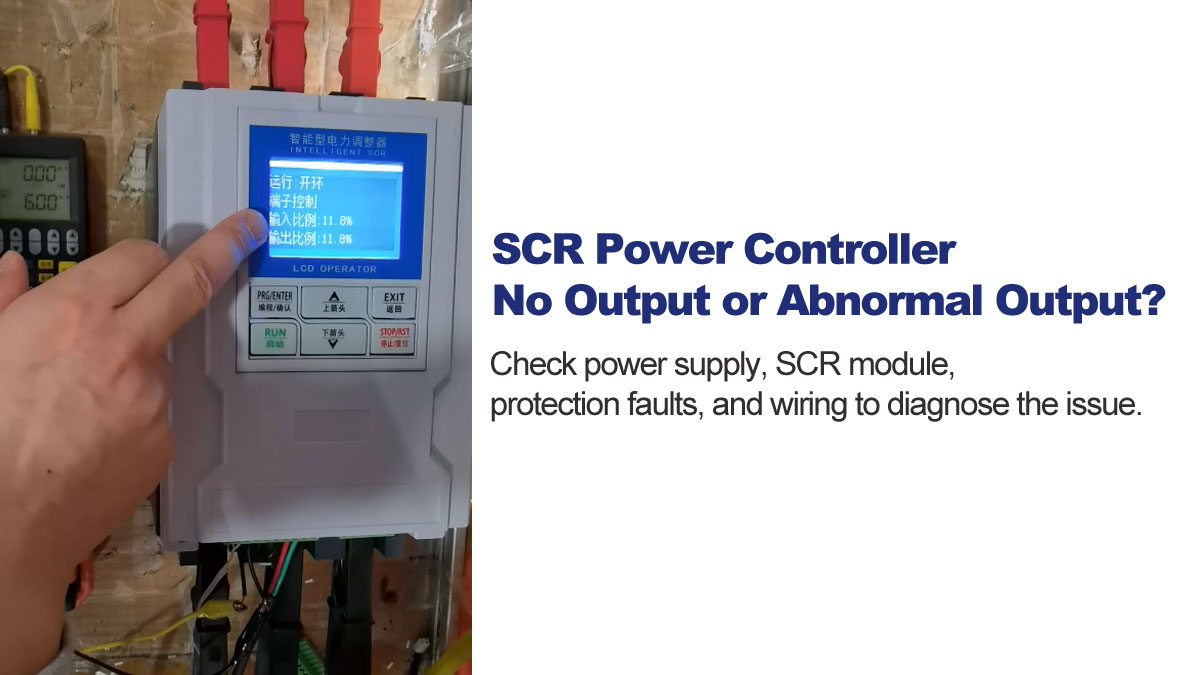
An SCR power controller that shows normal status on the display but delivers no output to the load is one of the most frustrating faults in industrial heating systems — the equipment appears fine, but production stops.
The fault is rarely obvious. It could be a power supply issue, a failed thyristor, a missing control signal, or a protection function that triggered without a clear alarm. Each cause requires a different fix.
This guide covers the six most common causes of no output or abnormal output in SCR power controllers, and a step-by-step process to locate the fault without guesswork.
SCR Power Controller No Output: Check Power Supply First
The power supply is always the first thing to check. Without stable input voltage, the controller cannot regulate output regardless of its internal condition.
Check for:
- Power outage or voltage instability on the input line
- Input voltage below the rated operating range
- Loose, broken, or improperly terminated power cables
- Internal power module failure
Measure input voltage at the terminals with a multimeter before proceeding to other checks.
Thyristor (SCR) Faults
The thyristor is the core switching component of the power controller. Two types of SCR failure produce different symptoms:
- Short circuit — the SCR conducts continuously, causing output voltage to be abnormally high even when the setpoint is low
- Open circuit — the SCR cannot conduct at all, resulting in zero output on the affected phase
Beyond the SCR itself, the trigger circuit can also fail. If the trigger signal is missing or timed incorrectly, the SCR will not switch on or off properly — producing irregular or unstable output even when the thyristor module is physically intact.
Control Signal Problems
The controller can only regulate output based on what the control signal tells it. If the signal from the PLC, temperature controller, or sensor is lost, incorrect, or affected by electromagnetic interference, the output will behave accordingly.
Common control signal faults:
- Signal loss due to a broken cable or disconnected terminal
- Incorrect signal type or range (e.g. 0–5V connected to a 4–20mA input)
- Interference from nearby motors, inverters, or transformers causing signal noise
If the control signal checks out, inspect the control board itself. Damaged capacitors, resistors, or ICs can cause signal processing errors that affect output regulation even when the input signal is correct.
Protection Functions Activated
SCR power controllers include built-in protection that will limit or shut down output under certain conditions. If protection has triggered, the controller may appear to be functioning normally while delivering no output.
Common triggers:
- Overload — load current exceeds the rated capacity, triggering current limiting or shutdown
- Overheating — blocked heatsink or fan failure causes the unit to exceed its thermal limit; over-temperature protection reduces or stops output until the unit cools
Check the controller display for fault codes before assuming a hardware failure.
External Wiring and Interference
Poor wiring is one of the most common causes of intermittent or abnormal output — and one of the easiest to overlook.
Check for:
- Loose terminal connections on input or output wiring
- Short circuits or broken cables in the load circuit
- Electromagnetic interference from nearby high-power equipment
SCR power controllers carry high current. A loose terminal that would be harmless in a low-current circuit can cause arcing, localized heating, and output instability at full load.
Step-by-Step Troubleshooting
Follow this sequence to locate the fault systematically:
- Check input power — measure voltage at the input terminals; confirm it is within the rated range and stable
- Inspect all wiring — check input, output, and control terminals for loose connections, damaged cables, or signs of arcing
- Verify the control signal — measure the signal at the input terminals; confirm the type, range, and value match the controller settings
- Check for active fault codes — read the display; if a protection function has triggered, resolve the underlying cause before resetting
- Test the SCR module — if the above checks pass, measure output voltage per phase; uneven or zero output on one phase points to a thyristor fault
- Inspect the control board — if all external checks are normal, internal component failure on the control board is the likely cause
Use a multimeter at each step to measure voltage, current, and continuity rather than relying on visual inspection alone.
FAQ
Q: The display shows normal but there is no output — where do I start?
A: Check the control signal first. If the controller is receiving a zero or missing signal, it will show normal status while delivering no output — this is expected behavior, not a fault.
Q: Output is present on two phases but zero on the third — what does this mean?
A: This points to a thyristor fault on the affected phase — most likely an open-circuit SCR. Check the thyristor module on that phase.
Q: The controller keeps shutting down after a few minutes of operation.
A: This is almost always an overheating issue. Check that the heatsink is clean, the fan is running, and the ambient temperature is within the rated operating range.
Browse our SCR Power Controllers for factory-direct pricing and technical support, or contact us to discuss your application.